The Whole Lemon, Used in Different Ways
A lemon is more useful when zest, juice, pith and peel are treated as distinct ingredients. The best result starts with one small decision before cutting.
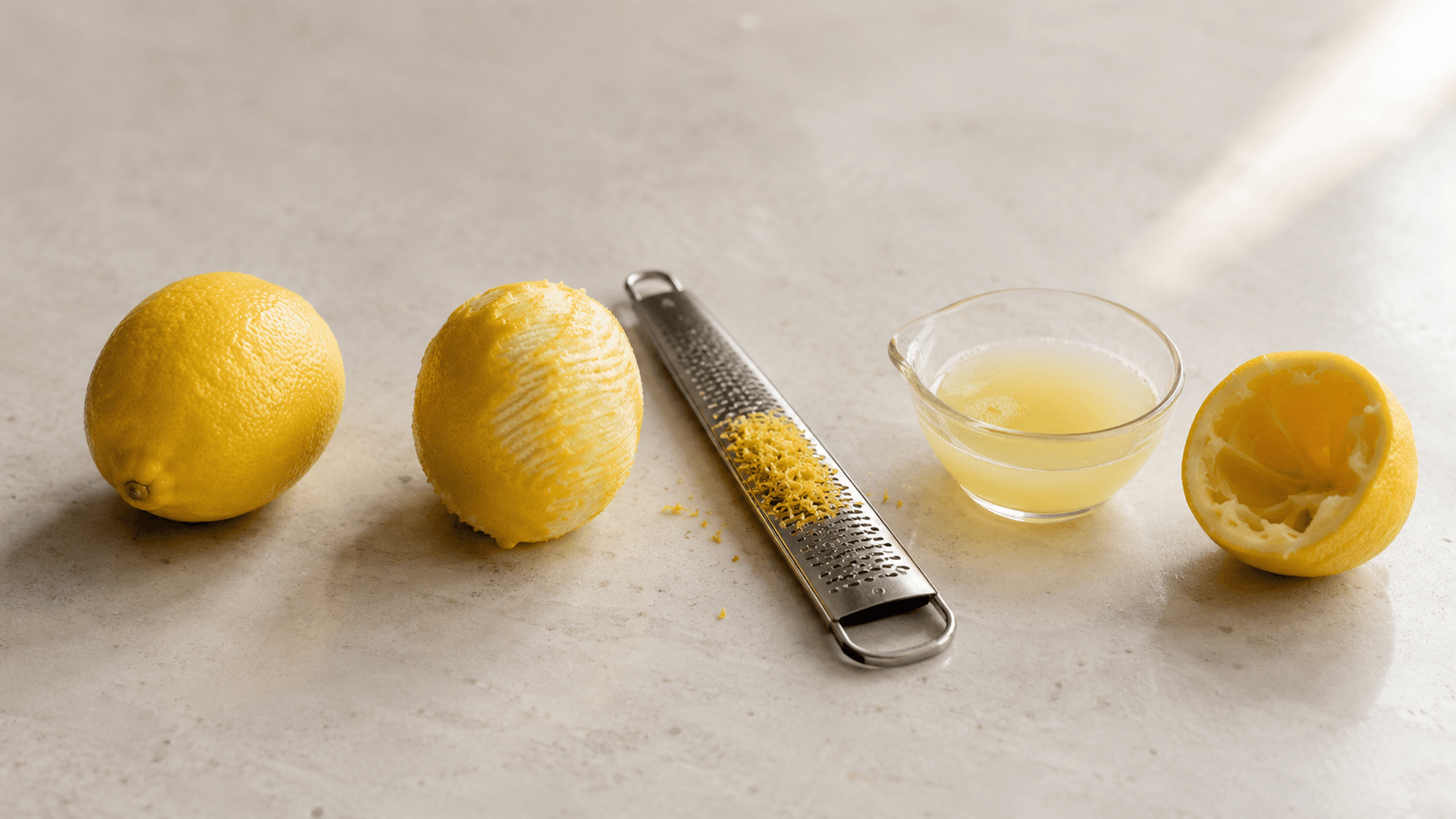
A lemon asks for an order of operations before it asks for a recipe.
Once the fruit is halved and squeezed, its smooth skin has become a slippery shell. The zest that could have gone into sugar, salt or butter is harder to remove cleanly. The remaining peel may still be useful, but the easiest opportunity has already passed.
This is why using a lemon well begins before the knife goes through it. Not with a vow to save every scrap, but with a more practical question: which part of the fruit does the food need?
Zest, juice, pith and peel are not interchangeable expressions of “lemon”. Each brings its own flavour, texture and behaviour. Treating them as separate culinary materials makes the fruit more useful—and often leaves less of it in the bin.
One fruit, several ingredients
The coloured outer layer of citrus peel is called the flavedo. It holds tiny oil glands and carries much of the aroma associated with freshly cut lemon. Beneath it sits the albedo: the white pith, a spongier layer rich in pectin and capable of contributing bitterness.1
Then there is the juice, which brings acidity as well as water. The seeds have their own properties, although in most everyday cooking they are removed rather than invited onto the plate.
The kitchen word peel often collapses the flavedo and albedo into one thing. That is convenient when both layers are being preserved, candied or sliced into marmalade. It is less useful when the cook wants fragrance without pith, or structure without an overwhelming amount of bitterness.
The first act of whole-fruit cooking is therefore not saving. It is separating.
Zest: aroma without acidity
Zest can make food smell vividly of lemon without adding the liquid or sharpness of its juice.
Grated into cake sugar, it perfumes the mixture while keeping the formula’s liquid balance intact. Worked into salt, butter or oil, it distributes aroma through a medium that can carry it across a dish. Added over vegetables, pasta or seafood near serving, it can make the first impression of lemon arrive through the nose before the acidity reaches the tongue.
None of these uses requires much zest. That is part of its strength. The question is not how much peel can be removed, but how lightly it can be taken.
A fine grater should collect the coloured surface rather than excavate the white layer beneath it. A peeler can remove broader strips for syrups, braises or infusions, where the zest can later be lifted out. The appropriate cut depends on whether the lemon is meant to disappear into the food or remain as a visible piece.
The practical rule is simple: zest while the fruit is still whole, firm and easy to hold. Juice can wait.
Juice: acidity with consequences
Lemon juice is often treated as a finishing squeeze, but its role is more exact than “making food brighter”.
It introduces acid and liquid together. In a dressing, that acidity may balance oil. In a pan sauce, it may pull richness back into focus. In lemon curd, it becomes part of a larger structure involving eggs, sugar and fat. In a cake or batter, an unmeasured squeeze can change more than flavour because it also changes the amount of liquid in the mixture.
Timing matters too. Juice cooked into a dish becomes part of its foundation; juice added at the end remains more immediate. Neither approach is universally better. A long-cooked sauce may need integrated acidity, while a finished soup may need only a small final adjustment.
This is why “add lemon” is incomplete advice. Add which part, at what stage, and for what job?
The answer may be zest for fragrance, juice for balance, or both for a fuller impression of the fruit. Using both does not mean adding them together automatically. It means allowing each one to arrive where it can do the most useful work.
Pith and peel need a method
Pith is often described only as something to avoid. For a fine garnish or clear infusion, removing it makes sense. Its bitterness and bulk can obscure the cleaner aroma of the outer zest.
Other preparations depend on the qualities that make pith inconvenient elsewhere.
Its pectin contributes to the structure of preserves such as marmalade, although the final set still depends on the preparation’s proportions and method. In candied peel, the thickness gives the finished piece substance. Water, blanching, sugar, salt or time may then be used to manage bitterness and transform the texture.
The point is not that pith is secretly delicious in every context. It is that suitability changes with technique.
A squeezed lemon shell can also become an ingredient beyond the meal that produced it. An SBS Food method from Alex Elliott-Howery and Sabine Spindler packs spent citrus skins in salt, allows them to preserve over several weeks, then rinses or soaks and slices them for stews, soups, marinades and dressings.2 Drying offers another route for peel intended for syrups, tea blends or other infusions.3
These are not ways to pretend waste has vanished. Preservation requires clean fruit, sound handling, appropriate storage and a genuine plan to use the result. A jar of peel forgotten at the back of a shelf is merely a delayed disposal.
Attention before waste
Australia wastes about 7.6 million tonnes of food each year, according to the federal Department of Climate Change, Energy, the Environment and Water.4 No careful use of a single lemon can carry the moral weight of that national problem. Food waste occurs across farms, processing, retail, hospitality and households; much of it cannot be solved through individual kitchen cleverness.
Still, the lemon exposes one everyday cause of avoidable waste: an ingredient is often discarded because its remaining uses were considered too late.
Whole-fruit cooking is easier when the cook decides early. If only the juice is needed today, the zest can be removed first and used immediately or stored appropriately. If several squeezed skins are likely to accumulate, a preservation method can be chosen before they begin to deteriorate. If there is no realistic use for the peel, composting or disposal may be more honest than keeping it out of obligation.
Waste reduction should not turn every offcut into homework. Nor should it demand that zest, juice, pith and peel all appear in the same dish. A whole lemon may be used across several preparations and several days: zest in a cake, juice in a dressing, peel in a preserve. The fruit remains whole in the thinking, not necessarily on the plate.
That distinction matters. Good ingredient use is not measured by how crowded the recipe becomes. It is measured by whether each part was noticed, understood and given an appropriate job.
Before cutting the next lemon, pause for the smallest piece of planning: zest first, juice next, peel only if there is a purpose.
Attention changes flavour before it changes waste.
- Mariana A. Andrade et al., “Citrus By-Products: Valuable Source of Bioactive Compounds for Food Applications”, Antioxidants 12, no. 1 (2023). The review distinguishes the oil-bearing coloured flavedo from the pectin-rich white albedo. The University of California’s Preserving Citrus guide also identifies bitter compounds and pectin in the albedo. ↩
- Alex Elliott-Howery and Sabine Spindler, “Salt-preserved citrus skins”, SBS Food. This is cited as one established preservation example, not as a universal method for every household or citrus preparation. ↩
- Mary Berg, “Dried citrus peels”, SBS Food, 23 May 2023. ↩
- Australian Government Department of Climate Change, Energy, the Environment and Water, “Reducing Australia’s food waste”. The estimate comes from the 2021 National Food Waste Strategy Feasibility Study and covers the Australian food system, not lemons specifically. ↩