Who Owns a Recipe After It Travels?
A recipe may be legally reusable and still carry creative, cultural and commercial obligations. What responsible adaptation asks of cooks, writers and businesses.
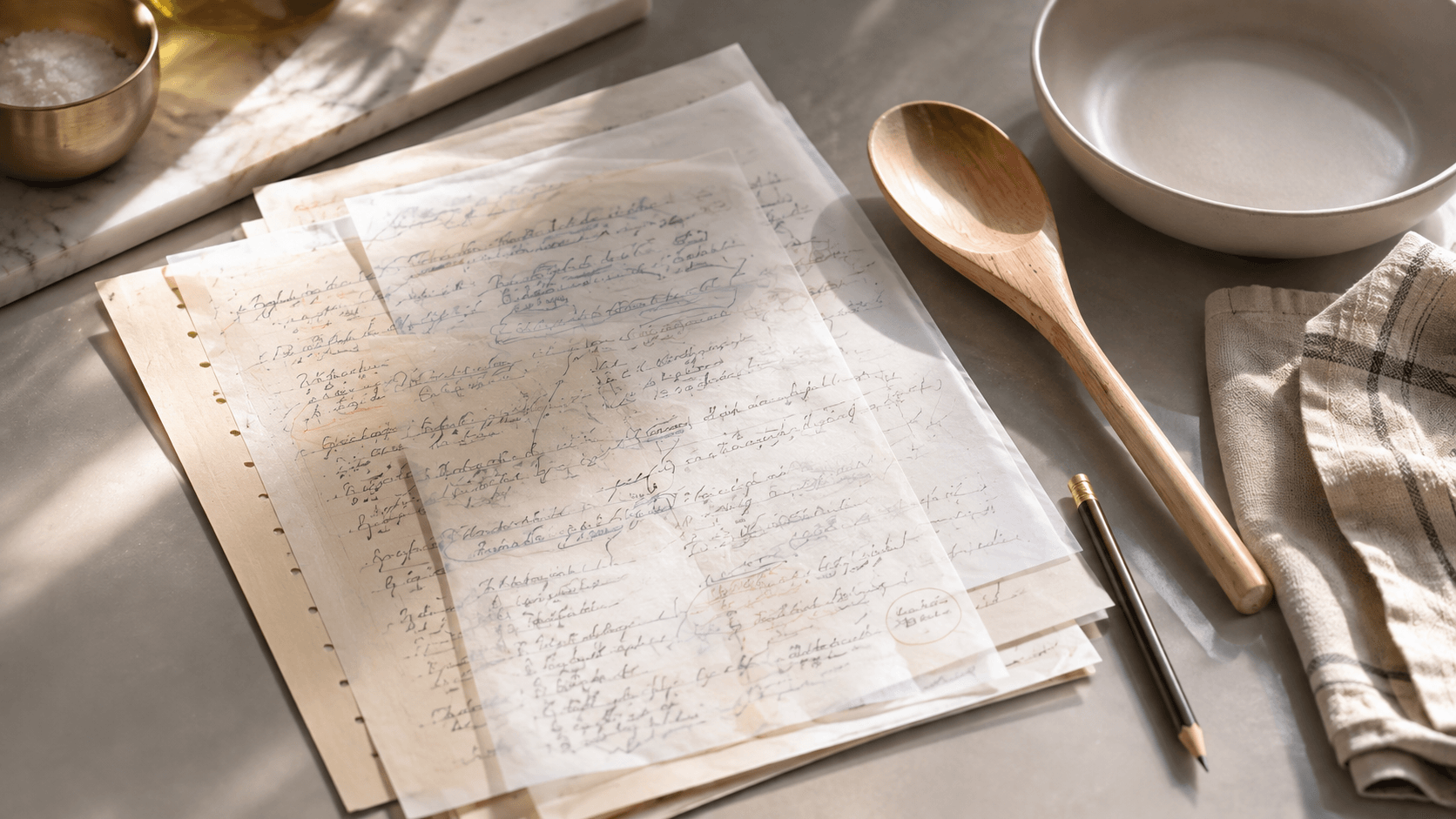
A recipe travels in more than one way. It moves through kitchens, but it also moves into bylines, menus, book contracts, television segments and businesses.
Each move changes who cooks the food and who is recognised as the authority behind it.
Cooking and claiming are separate acts. A person may have every practical ability to prepare a dish and still need to explain the source of a published version.
A business may be free to use a general method while carrying obligations around cultural knowledge, consent or commercial benefit.
Rather than searching for one owner, it is more useful to identify the claim being made.
Written expression, creative labour, cultural authority and permission to use knowledge are different interests.
They can belong to different people at the same time.
Credit is a practical record
When a recipe writer adds adapted from, learnt from, inspired by or a version of to a headnote, the phrase does practical work.
It tells the reader which part was inherited and which part the writer contributed.
Three Australian cookbook practitioners interviewed by the ABC in 2025 described different versions of this discipline.
Chef Andreas Papadakis said he identifies the regions and methods behind traditional dishes when developing a version of his own.
Hetty Lui McKinnon discussed acknowledging sources, influences and fellow writers while distinguishing established recipes from a developer’s particular perspective.
Alice Zaslavsky emphasised the value of supplying context.1
Together, those approaches make lineage useful to the cook. A reader can follow the influence, understand the new contribution and judge the version on accurate terms.
Credit becomes information rather than ceremonial gratitude.
This is especially important when development draws on another writer’s tested work.
Changing a garnish, shortening an explanation or adjusting a quantity does not, by itself, explain where the working foundation came from.
A short, accurate attribution can.
Copyright and culinary lineage
Australian copyright guidance places protection around an original work recorded in material form rather than around the underlying idea, method or concept.
For a recipe, protected material may include original prose, photographs and a particular written presentation.2
That distinction can answer whether creative expression has been copied. Culinary lineage asks something else: whose teaching, testing or inherited knowledge made the new version possible.
A method can be legally available and culturally situated at the same time.
The law therefore protects one part of the work. Attribution can record another.
Neither task requires food to stop changing; each asks for a more accurate account of how the published version came to exist.
Scale brings power
Private cooking and public claims carry different consequences.
In an SBS Food discussion, comedian and food presenter Jennifer Wong distinguished a home cook respectfully following a cookbook from a chef presenting another culture’s dish as an invention or personal twist.
When she prepared coconut dahl with gai lan and tomato sambol, Wong named Meera Sodha and Rupal Bhatikar as recipe influences.3
At home, the result usually stays within a private meal. On a restaurant menu, in a cookbook, on television or through a large social account, the same act can generate money, reputation and explanatory authority.
Attribution then works as a public record, showing an audience which knowledge entered the finished version.
Cultural belonging matters, but it cannot act as the only licence.
Both insiders and outsiders carry responsibilities.
Skill can be developed through study, mentorship and serious practice; cultural background alone does not make every version careful or representative.
The relevant test is the relationship between the knowledge used, the claim made and the power attached to that claim.
Authority extends beyond the cook
Food is also interpreted by editors, publishers, reviewers and broadcasters.
Their decisions influence who is commissioned, quoted and believed.
Australian food writer Lee Tran Lam’s position, reported by the ABC in 2020, left room for people to write beyond their own cultural background and emphasised respect, open-mindedness and context.
The report also examined how food media can assign complexity and prestige unevenly across cuisines.4
A publication can provide an accurate recipe credit and still narrow the culture around it.
Treating one cook as the definitive voice for a region, or repeatedly rewarding the borrower while overlooking the people who taught the food, changes how authority accumulates.
Representation includes the architecture around the recipe: who receives space to explain, who is treated as an expert, and whose name continues to travel with the dish.
Indigenous Knowledge requires a separate frame
In Australia, discussion of recipe ownership must distinguish ordinary culinary influence from Indigenous Knowledge.
IP Australia describes this knowledge as held by Aboriginal and Torres Strait Islander people, communities, organisations and businesses.
It may be communal, and traditional methods and skills often sit outside the effective protection of existing intellectual-property systems.
Businesses engaging with Indigenous Knowledge are advised to seek informed consent and permission, document the agreed approach and discuss benefit-sharing with Traditional Custodians.
The guidance also distinguishes knowledge available for commercial use under agreed protocols from knowledge that may be secret or sacred.5
The economic stakes are documented, although the evidence has limits. A 2022 review of Australian literature published from 2005 to 2018, with particular attention to northern Australia, reported that Indigenous knowledge had contributed to the commercial development of more than 15 bush-food species.
The authors identified opportunities for Indigenous-led livelihoods alongside substantial social, cultural and legal challenges affecting whether benefits are realised.6
Different bodies of knowledge carry different conditions.
A published recipe, family instruction, ceremonial practice and communally held knowledge are not interchangeable.
In practice, responsible use may call for simple attribution in one case and consultation, consent or negotiated benefit-sharing under relevant community protocols in another.
Four decisions before making a public claim
Identify the material. Record whether the starting point was a general technique, a published recipe, a teacher’s instruction, family knowledge or a governed body of communal knowledge.
Describe the contribution. Present an interpretation as an interpretation. Name a version as a version. Reserve claims of invention for work that can honestly carry them.
Keep contributors visible. Name the writer, teacher, family, community, restaurant or tradition when the path is known and public attribution is appropriate.
Account for benefit. Consider sales, attention, professional status and control of intellectual property. Where governed knowledge is involved, establish whether permission and an agreed share of benefit are required before use.
Recipes thrive because cooks learn, teach and adapt. Responsibility becomes sharper when that movement turns into a public claim: a byline, a menu description, a business asset or a declaration of expertise.
Accurate attribution, appropriate consent and a fair account of benefit show what the new version recognises.
A recipe can be shared widely while the obligations around it remain specific.
Source notes
- Anna Chisholm, “Cookbook authors share their process after the RecipeTin Eats-Brooke Bellamy recipe accusations”, ABC News, 1 May 2025, https://www.abc.net.au/news/2025-05-01/recipe-creation-recipe-tin-eats-brooke-bellamy-accusations/105235536. ↩
- Arts Law Centre of Australia, “Copyright”, accessed 4 August 2026, https://www.artslaw.com.au/information-sheet/copyright/. ↩
- Yasmin Noone, “When is it okay to ‘steal’ food or recipes?”, SBS Food, 20 April 2022, https://www.sbs.com.au/food/the-cook-up-with-adam-liaw/article/when-is-it-okay-to-steal-food-or-recipes/tvbssb1j4. ↩
- Hannah Reich and Teresa Tan, “Australian food writers call for greater diversity of voices in wake of New York Times durian debacle”, ABC News, 6 August 2020, https://www.abc.net.au/news/2020-08-06/food-culture-media-diversity-australia-durian/12522524. ↩
- IP Australia, “Indigenous Knowledge” and “Respectful use of Indigenous Knowledge”, accessed 4 August 2026, https://www.ipaustralia.gov.au/understanding-ip/indigenous-knowledge and https://www.ipaustralia.gov.au/understanding-ip/indigenous-knowledge/how-to-engage-indigenous-knowledge. ↩
- Diane Jarvis, Kirsten Maclean and Emma Woodward, “The Australian Indigenous-led bush products sector: Insights from the literature and recommendations for the future”, Ambio 51, no. 1 (2022): 226–240, https://doi.org/10.1007/s13280-021-01542-w. ↩